US citizens or Green Card holders residing in India – Your due date to file your 2011 US Individual Income tax return is June 15th 2012.



Many of my friends called me last week from US and told me that many Indian banks were calling and suggesting them to transfer US dollars to India due to an all time high rate of Rupees 56 to a dollar.
Internal Revenue Services (“IRS”) has allowed U.S. Citizens and Resident Aliens Abroad an automatic 2 month extension of time to file their tax return and pay any federal income tax that is due.
You will be allowed the extension if you are a U.S. citizen or resident alien and on the regular due date of your return:
(i) You are living outside of the United States and Puerto Rico and your main place of business or post of duty is outside the United States and Puerto Rico, or
(ii) You are in military or naval service on duty outside the United States and Puerto Rico
If you use a calendar year, the regular due date of your return is April 15, and the automatic extended due date would be June 15.
In case of Married Taxpayers who are filing joint returns, either you or your spouse can qualify for the automatic extension. If you and your spouse file separate returns, this automatic extension applies only to the spouse who qualifies.
How To Get The Extension:
To use this automatic 2-month extension, you must attach a statement to your return explaining which of the two situations listed earlier qualified you for the extension.
Due to improved detection systems and computerized checks, the IRS can more easily identify red flags that trigger audits. It typically starts with a letter requesting more information and can lead to in-person meetings. It’s usually triggered by a tax return that contains something unusual, such as an above-average deduction or change in income from previous years. As long as the taxpayer can defend his filings with the proper paperwork and logic, they have nothing to worry about.
Here are some of the signs that you need to look into:
1. Making lot less money last year
The IRS looks out for any major changes in income, which can signify that a taxpayer is under-reporting his earnings. Since the IRS tracks historic data, people who suddenly start reporting much less income can be flagged for an audit.
2. Making too much money
Although the overall individual audit rate is about 1.11%, the odds increase dramatically for higher-income filers. IRS statistics show that people with incomes of $200,000 or higher had an audit rate of 3.93%, or one out of slightly more than every 25 returns. Report $1 million or more of income? There’s a one-in-eight chance your return will be audited. The audit rate drops significantly for filers making less than $200,000: Only 1.02% of such returns were audited during 2011, and the vast majority of these exams were conducted by mail. We’re not saying you should try to make less money — everyone wants to be a millionaire. Just understand that the more income shown on your return, the more likely it is that you’ll be hearing from the IRS.
3. Deductions above average
IRS keeps a track of average deduction in each category. The IRS looks for higher-than-average deductions in each category as a signal that things may not be right.
4. If you’re paid in cash
The IRS knows that you can more easily under report what you earn. If you’re honest about your own accounting you can avoid that audit or if audited, escape heavy fines and fees.
5. If you earn income from selling items online
If you own an online business and make a profit, make sure you report your income. Keep in mind that your selling or payment processing service, such as eBay or PayPal, is reporting sales and the IRS will notice if this income is missing on your tax return.
6. Failing to report all taxable income
Since employers send copies of all 1099 forms and W-2 forms to the IRS as well as to you, if you lose your version or forget to file it with your taxes, the IRS can flag your return for review. You want to make sure the information you provide to the IRS matches up with any other information they are receiving about you.
7. You work for yourself
It might not seem fair, but being self-employed can raise red flags for the IRS, especially if you claim your home office and other costs as business expenses but don’t earn much income. Keep careful track of all paperwork so you can defend any deductions and credits you take.
8. You claim losses from a hobby
While writing off business expenses can be legitimate, it’s illegal to pretend a hobby is a business and then write off the related expenses. For example, if you enjoy woodworking, you might practice the craft on the weekends for fun. Doing so does not enable you to write off the cost of wood and tools. (If you were selling those creations online, that would be a different story.)
9. Deducing home office (or car) expenses
While plenty of people can legitimately claim home office expenses on their taxes, some people do so incorrectly. Merely checking email from home after work, for example, does not justify a home office deduction. In order to qualify, the home office must be used for work only. Likewise, claiming a car as a business expense can also raise red flags. If you are doing this keep careful track of how much use of the car for business versus personal use.
10. You included expensive meals and entertainment costs among your deductions
The IRS often double-checks these types of claims to make sure they are legitimate business expenses.
11. Taking large charitable deductions
IRS is on the lookout for people who inflate their charitable donations, and that the agency takes a close look at taxpayers who say they donated $500 or just under, since anyone who donates more than that amount must file form 8283.
12. You maintain an overseas bank account
The IRS has added more reporting requirements this year for people with money in foreign accounts. Failing to report one could trigger an audit.
13. Your numbers don’t match
If numbers on various forms don’t match or add up correctly, the IRS is likely to notice and look into any disparities. So treat your taxes like a final exam in algebra and check over all the numbers before submitting.
Although there’s no sure way to avoid an IRS audit, you should be aware of red flags that could increase your chances of drawing unwanted attention from the IRS.
In a major development, U.S. declares “FATCA partners” with five countries whereby each pledge more tax information sharing between the Governments. The five countries are France, Germany, Italy, Spain and the United Kingdom.
Extracts of the report:
Under Treasury’s proposed “new government-to-government framework for implementing FATCA,” the governments of France, Germany, Italy, Spain and the United Kingdom will work together to create a means to collect the information from their banks and send it to the United States.
Treasury said that once these five “FATCA partner” countries finalized the framework, banks in those countries would not have to enter into separate data disclosure agreements with the IRS.
In addition, in a reciprocating agreement, Treasury said the United States would collect and share information with the five participating EU countries about accounts held by their citizens in U.S. financial institutions.
For nations not invited to become “FATCA partners” with the United States, banks and financial institutions in those countries must still cooperate on their own with the IRS.
Noticeably absent from the new framework were major international banking nations such as Canada, Switzerland and the Netherlands, not to mention tax haven jurisdictions such as Ireland, the Cayman Islands and Bermuda.
Entire Reuters article can be read here
http://www.reuters.com/article/2012/02/08/usa-tax-treasury-fatca-idUSL2E8D82J120120208
We came across an advertisement from one of the prominent Indian bank, which said “. . . . Bank offers its NRI customers a never before opportunity to avail up to 9.5%* interest rates on NRE Fixed Deposits. With 100% repatriation, complete tax exemption on the entire interest amount and the soaring exchange rates you are sure to gain maximum returns”
We at NS Global wanted to bring clarity to the Investors on the term “complete tax exemption on the entire interest amount”.
Let us understand Indian Tax laws.
Under the Indian Income Tax Act, Interest income from Non Resident External Account (NRE A/c.) is exempt from tax under section 10(4).
So far so good.
Now let us understand from US point of view.
We have decided to draw a chart to explain the provisions.
| Person who is a: | Individual residing in USA | Individual residing in India |
| US Citizen | The person is required to disclose its world wide income in its US Income tax return. So, even though this interest income is tax free inIndia, it would be still taxable in US.The person won’t have any benefit of Indo-US tax treaty due to Article 1(3) of the treaty. | Same provisions as if the person was residing inUSA. |
| US Green Card holder or a US Resident Alien | The person is required to disclose its world wide income in its US Income tax return. So, even though this interest income is tax free inIndia, it would be still taxable in US.The person won’t have any benefit of Indo-US tax treaty. | The person is required to disclose its world wide income in its US Income tax return.However, the person can claim the benefit under the “tie-breaker rules” of the Indo-US tax treaty.
If you are a resident of the treaty country under the tie-breaker rule and you elect to apply the treaty, you will be considered to be a resident of the treaty country forU.S.income tax purposes.
Thus, you would not be liable to pay tax on the NRE Interest income and will not be required to file a U.S. Resident Alien Income Tax Return (Form 1040).
To make this election, you must file a U.S. Nonresident Alien Income Tax Return (Form 1040NR) in the year of the election and attach a copy of Form 8833. |
Please note that you are still required to be compliant on your annual FBAR filing.
Hope the above would bring enough clarity on the term “complete tax exemption on the entire interest amount” to the Investors.
For tax years beginning after March 18, 2010, certain individuals must file new Form 8938 to report the ownership of specified foreign financial assets if the total value of those assets exceeds the reporting threshold amount.
Who Must File: Unless an exception applies, you must file Form 8938 if you are a specified person that has an interest in specified foreign financial assets and the value of those assets is more than the applicable reporting threshold.
Exception: If you do not have to file an income tax return for the tax year, you do not have to file Form 8938, even if the value of your specified foreign financial assets is more than the appropriate reporting threshold.
Specified individual: You are a specified individual if you are one of the following:
1. A U.S. citizen
2. A resident alien of the United States for any part of the tax year
3. A nonresident alien who makes an election to be treated as a resident alien for purposes of filing a joint income tax return
Specified foreign financial assets: Generally include the following assets:
1. Any financial account maintained by a foreign financial institution.
2. To the extent held for investment and not held in a financial account, any stock or securities issued by someone that is not a U.S. person, any interest in a foreign entity, and any financial instrument or contract with an issuer or counterparty that is not a U.S. person.
Reporting threshold: If the total value of your specified financial assets is more than the following:
|
Taxpayer living in United States |
Taxpayer living abroad |
|||
|
On the last day of the tax year |
Anytime during the tax year |
On the last day of the tax year |
Anytime during the tax year |
|
| Unmarried | $50,000 | $75,000 | $200,000 | $300,000 |
| Married filing jointly | $100,000 | $150,000 | $400,000 | $600,000 |
| Married filing separately | $50,000 | $75,000 | $200,000 | $300,000 |
Form 8938 does not relieve you of the requirement to file FBAR form TD F 90-22.1
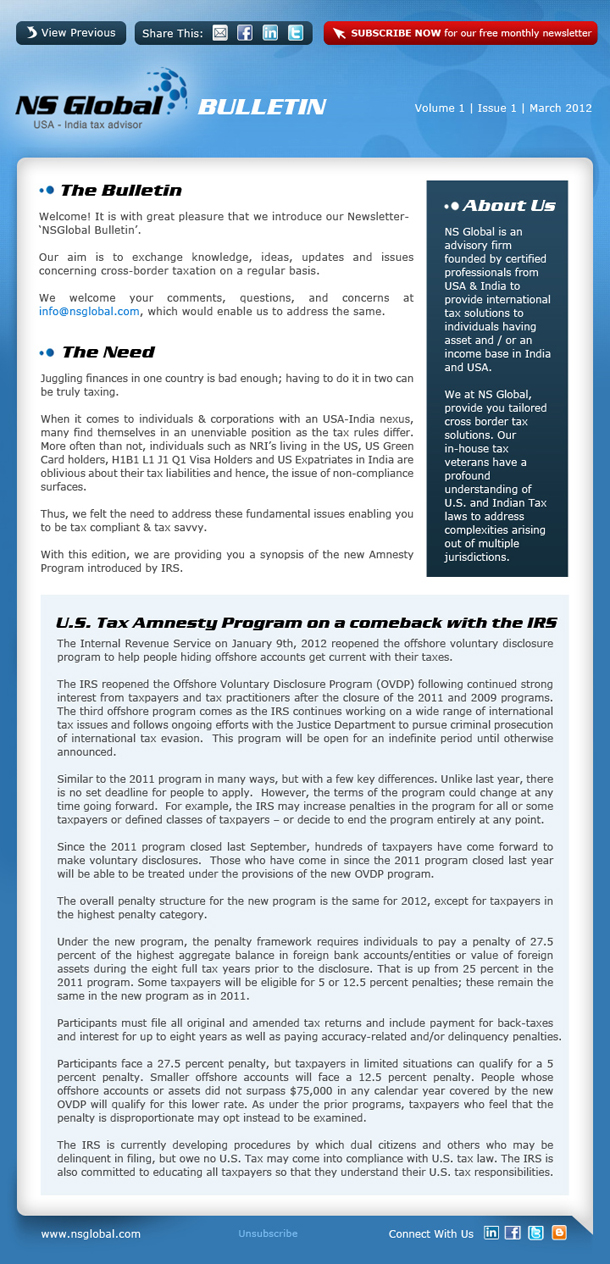
The Internal Revenue Service on January 9th, 2012 reopened the offshore voluntary disclosure program to help people hiding offshore accounts get current with their taxes.
The IRS reopened the Offshore Voluntary Disclosure Program (OVDP) following continued strong interest from taxpayers and tax practitioners after the closure of the 2011 and 2009 programs. The third offshore program comes as the IRS continues working on a wide range of international tax issues and follows ongoing efforts with the Justice Department to pursue criminal prosecution of international tax evasion. This program will be open for an indefinite period until otherwise announced.
The program is similar to the 2011 program in many ways, but with a few key differences. Unlike last year, there is no set deadline for people to apply. However, the terms of the program could change at any time going forward. For example, the IRS may increase penalties in the program for all or some taxpayers or defined classes of taxpayers – or decide to end the program entirely at any point.
Since the 2011 program closed last September, hundreds of taxpayers have come forward to make voluntary disclosures. Those who have come in since the 2011 program closed last year will be able to be treated under the provisions of the new OVDP program.
The overall penalty structure for the new program is the same for 2011, except for taxpayers in the highest penalty category.
For the new program, the penalty framework requires individuals to pay a penalty of 27.5 percent of the highest aggregate balance in foreign bank accounts/entities or value of foreign assets during the eight full tax years prior to the disclosure. That is up from 25 percent in the 2011 program. Some taxpayers will be eligible for 5 or 12.5 percent penalties; these remain the same in the new program as in 2011.
Participants must file all original and amended tax returns and include payment for back-taxes and interest for up to eight years as well as paying accuracy-related and/or delinquency penalties.
Participants face a 27.5 percent penalty, but taxpayers in limited situations can qualify for a 5 percent penalty. Smaller offshore accounts will face a 12.5 percent penalty. People whose offshore accounts or assets did not surpass $75,000 in any calendar year covered by the new OVDP will qualify for this lower rate. As under the prior programs, taxpayers who feel that the penalty is disproportionate may opt instead to be examined.
The IRS is currently developing procedures by which dual citizens and others who may be delinquent in filing, but owe no U.S. tax may come into compliance with U.S. tax law. The IRS is also committed to educating all taxpayers so that they understand their U.S. tax responsibilities.
More details will be posted on our blog, as it becomes available.
Official announcement can be read here http://www.irs.gov/newsroom/article/0,,id=252162,00.html?portlet=108
Let me first give you all a brief background of tax system in both countries (i.e. India and USA).
In India, the income tax is levied on the income that is generated during a fiscal year which commences on 1st April and ends on 31st March of each year. The due date of filing the Individual tax return is 31st July.
In USA, the income tax is levied on the income that is generated during a calendar year which commences on 1st January and ends on 31st December of each year. The due date of filing the Individual tax return is 15th April.
Firstly, a taxpayer who pays or accrues a foreign income tax may not take the tax into account in calculating the foreign tax credit or deduction until the related income is taken into account for USA income tax purposes.
So let us assume that you have disclosed all your income generated in India in your USA Tax Return. This includes income that is tax free in India e.g. Dividend Income, PPF (Public Provident Fund) interest, Long Term Capital Gain (on listed Companies), etc.
Now the question, how can you claim the benefit of taxes paid in India on your USA Tax Return.
USA tax payer is allowed a credit or deduction against USA income liability for foreign taxes paid or accrued to a foreign country. Qualified foreign taxes do not include taxes that are refundable to you or used to provide a subsidy to you.
You can choose to take the amount of any qualified foreign income taxes paid or accrued during the year as a foreign tax credit or as a deduction.
To choose the deduction, you must itemize deductions on Form 1040, Schedule A.
To choose the foreign tax credit you generally must complete Form 1116 and attach it to your Form 1040.
If you use Form 1116 to figure the credit, your foreign tax credit will be the smaller of the amount of foreign tax paid or accrued, or the amount of United States tax attributable to your foreign source income. Penalties, interest, fines and similar obligations are not creditable foreign taxes.
Generally, it is more advantageous for a USA tax payer to claim the tax credit because it is taken against the tax payers USA liability on a dollar-for-dollar basis. In contrast, a deduction for foreign taxes merely reduces a taxpayers income subject to tax.
Credit or Deduction shall be taken as follows:
Now someone may ask after reading 1 to 4 above, what if I had a refund in the foreign country. Well then you need to find out what is your Average Rate of Tax and take credit only to that extent.
So what is Average Rate of Tax:
Let us take an example: You have following Income:
Interest INR 300,000
Other Income INR 200,000
Short Term Capital Gain INR 500,000
Total Income INR 1,000,000
Tax on the Above Income INR 150,000
Less: TDS on Interest INR 60,000
Less: TDS on Other Income INR 40,000
Less: Advance Tax paid INR 200,000
Refund Due INR 50,000
Now you cannot claim the entire TDS and Advance Paid as your credit as you got a refund of INR 50,000. Your Average Rate of Tax would be 15% and not 20%. You can claim credit to the extent of 15%.
The bottom line is that you can take credit or deduction of taxes paid in the foreign country towards the foreign income disclosed in your USA tax return. The credit or deduction should not be more that the Average Rate of Tax that you paid in the foreign county.
As you would only come to know about your Average Rate when you file the return in the foreign country (in India by July 31st ), you have two alternatives: Either file for an automatic extension of six months in USA or estimate what your Average Rate of Tax is going to be in the foreign county (if it turns out that your estimate was incorrect then the final arrived percentage, then you will have to revise your return).
Foreign Tax Credit involves complex analysis of each transaction. There are special rules for allow credit only of fulfillment of certain criteria’s. Please consult knowledgeable USA – India Tax advisor for proper tax disclosure and maximum tax benefits.