List of IRS forms that 1040 filers can begin filing in late February or into March 2013

Posted by Sanket Shah | International Tax | Tuesday 29 January 2013 2:43 pm

The following tax forms will be accepted by the IRS in late February or into March after updating forms and completing programming and testing of its processing systems.  A specific date will be announced in the near future.

Form 3800 General Business Credit
Form 4136 Credit for Federal Tax Paid on Fuels
Form 4562 Depreciation and Amortization (Including Information on Listed Property)
Form 5074 Allocation of Individual Income Tax to Guam or the Commonwealth of the Northern Mariana Islands
Form 5471 Information Return of U.S. Persons With Respect to Certain Foreign Corporations
Form 5695 Residential Energy Credits
Form 5735 American Samoa Economic Development Credit 
Form 5884 Work Opportunity Credit
Form 6478 Credit for Alcohol Used as Fuel
Form 6765 Credit for Increasing Research Activities
Form 8396 Mortgage Interest Credit
Form 8582 Passive Activity Loss Limitations
Form 8820 Orphan Drug Credit
Form 8834 Qualified Plug-in Electric and Electric Vehicle Credit
Form 8839 Qualified Adoption Expenses
Form 8844 Empowerment Zone and Renewal Community Employment Credit
Form 8845 Indian Employment Credit
Form 8859 District of Columbia First-Time Homebuyer Credit
Form 8864 Biodiesel and Renewable Diesel Fuels Credit
Form 8874 New Markets Credits
Form 8900 Qualified Railroad Track Maintenance Credit
Form 8903 Domestic Production Activities Deduction
Form 8908 Energy Efficient Home Credit
Form 8909 Energy Efficient Appliance Credit
Form 8910 Alternative Motor Vehicle Credit
Form 8911 Alternative Fuel Vehicle Refueling Property Credit
Form 8912 Credit to Holders of Tax Credit Bonds
Form 8923 Mine Rescue Team Training Credit
Form 8932 Credit for Employer Differential Wage Payments
Form 8936 Qualified Plug-in Electric Drive Motor Vehicle Cred

Share

IRS To Accept Returns Claiming Education Credits by Mid-February

Posted by Sanket Shah | International Tax | Tuesday 29 January 2013 11:33 am

On January 28th, 2013, the Internal Revenue Service announced that processing of tax returns claiming education credits will begin by the middle of February. 

Taxpayers using Form 8863, Education Credits, can begin filing their tax returns after the IRS updates its processing systems. Form 8863 is used to claim two higher education credits — the American Opportunity Tax Credit and the Lifetime Learning Credit.

The IRS emphasized that the delayed start will have no impact on taxpayers claiming other education-related tax benefits, such as the tuition and fees deduction and the student loan interest deduction. People otherwise able to file and claiming these benefits can start filing Jan. 30.

As it does every year, the IRS reviews and tests its systems in advance of the opening of the tax season to protect taxpayers from processing errors and refund delays. The IRS discovered during testing that programming modifications are needed to accurately process Forms 8863.
 
The IRS remains on track to open the tax season on Jan. 30 for most taxpayers. The Jan. 30 opening includes people claiming the student loan interest deduction on the Form 1040 series or the higher education tuition or fees on Form 8917, Tuition and Fees Deduction.

Share

IRS Announces Simplified Option for Claiming Home Office Deduction

Posted by Sanket Shah | International Tax | Wednesday 16 January 2013 3:41 pm

On January 15, 2013, the Internal Revenue Service (“IRS”) announced a simplified option that many owners of home-based businesses and some home-based workers may use to figure their deductions for the business use of their homes.

The new optional deduction, capped at $1,500 per year based on $5 a square foot for up to 300 square feet.

This will reduce the paperwork and recordkeeping burden on small businesses by an estimated 1.6 million hours annually.

“This is a common-sense rule to provide taxpayers an easier way to calculate and claim the home office deduction,” said Acting IRS Commissioner Steven T. Miller. “The IRS continues to look for similar ways to combat complexity and encourages people to look at this option as they consider tax planning in 2013.”

The new option provides eligible taxpayers an easier path to claiming the home office deduction. Currently, they are generally required to fill out a 43-line form (Form 8829) often with complex calculations of allocated expenses, depreciation and carryovers of unused deductions.  Taxpayers claiming the optional deduction will complete a significantly simplified form.

Though homeowners using the new option cannot depreciate the portion of their home used in a trade or business, they can claim allowable mortgage interest, real estate taxes and casualty losses on the home as itemized deductions on Schedule A. These deductions need not be allocated between personal and business use, as is required under the regular method.

Business expenses unrelated to the home, such as advertising, supplies and wages paid to employees are still fully deductible.

Current restrictions on the home office deduction, such as the requirement that a home office must be used regularly and exclusively for business and the limit tied to the income derived from the particular business, still apply under the new option. 

The new simplified option is available starting with the 2013 return which most taxpayers will be filing early in 2014.

Share

2013 Revised Tax Rates

Posted by Sanket Shah | International Tax | Tuesday 15 January 2013 12:49 pm

On January 11, 2013, Internal Revenue Service announced annual inflation adjustments for tax year 2013, including the tax rate schedules, and other tax changes from the recently passed American Taxpayer Relief Act of 2012.

The revised tax rates are as follows:

The other changes that are of great interest to most taxpayers include the following:

1. The standard deduction rises to $6,100 ($12,200 for married couples filing jointly), up from $5,950 ($11,900 for married couples filing jointly) for tax year 2012.

2. The American Taxpayer Relief Act of 2012 added a limitation for itemized deductions claimed on 2013 returns of individuals with incomes of $250,000 or more ($300,000 for married couples filing jointly).

3. The personal exemption rises to $3,900, up from the 2012 exemption of $3,800. However beginning in 2013, the exemption is subject to a phase-out that begins with adjusted gross incomes of $250,000 ($300,000 for married couples filing jointly). It phases out completely at $372,500 ($422,500 for married couples filing jointly.)

4. The Alternative Minimum Tax exemption amount for tax year 2013 is $51,900 ($80,800, for married couples filing jointly), set by the American Taxpayer Relief Act of 2012, which indexes future amounts for inflation. The 2012 exemption amount was $50,600 ($78,750 for married couples filing jointly).

5. The maximum Earned Income Credit amount is $6,044 for taxpayers filing jointly who have 3 or more qualifying children, up from a total of $5,891 for tax year 2012.

6. Estates of decedents who die during 2013 have a basic exclusion amount of $5,250,000, up from a total of $5,120,000 for estates of decedents who died in 2012.

7. For tax year 2013, the monthly limitation regarding the aggregate fringe benefit exclusion amount for transit passes and transportation in a commuter highway vehicle is $245, up from $240 for tax year 2012 (the legislation provided a retroactive increase from the $125 limit that had been in place).

Share

Fiscal cliff deal raises 2013 tax rates

Posted by Sanket Shah | Newsletters | Saturday 5 January 2013 3:54 pm
January Header
Newsletter - January 2012

NSGlobal Newsletter - September NSGlobal Newsletter - January NSGlobal Newsletter - January NSGlobal Newsletter - January NSGlobal Newsletter - January NSGlobal Newsletter - January Unsubscribe Linkedin Facebook Twitter Blog
Share

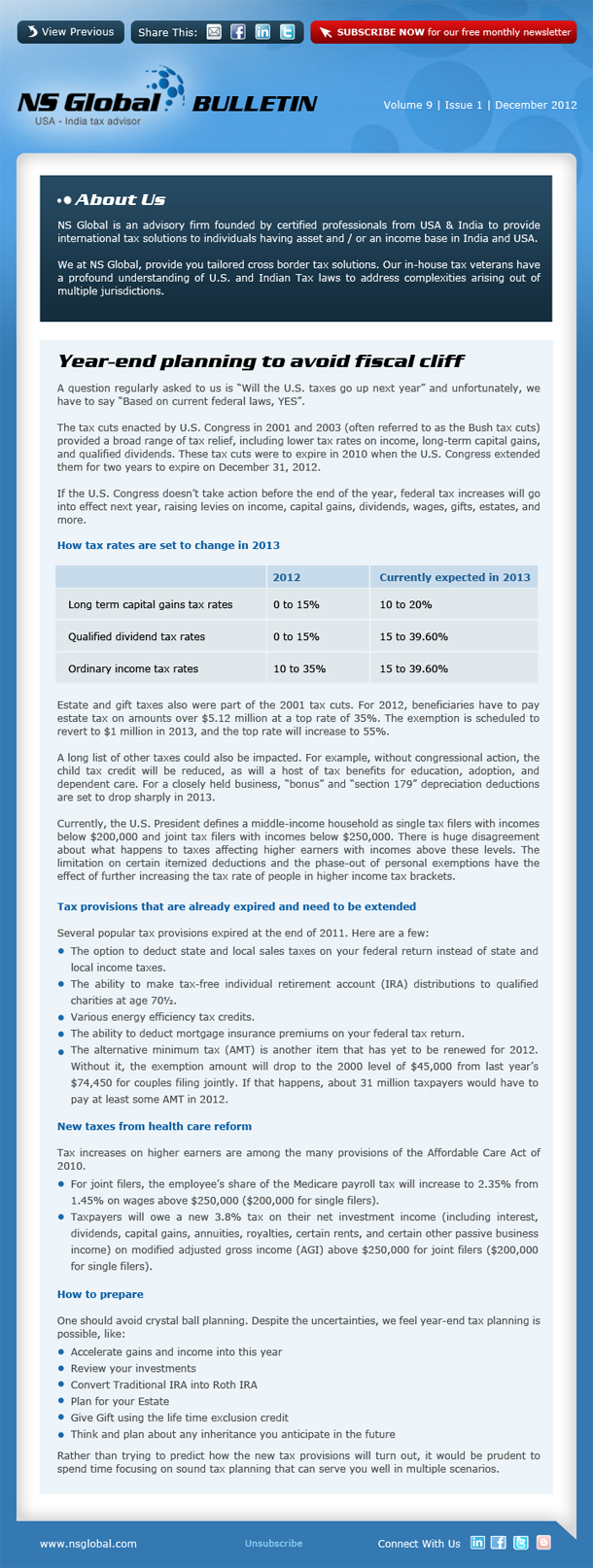
Year-end planning to avoid fiscal cliff

Posted by Sanket Shah | Newsletters | Thursday 6 December 2012 4:36 pm
December Header
Newsletter - December 2012

NSGlobal Newsletter - September NSGlobal Newsletter - December NSGlobal Newsletter - December NSGlobal Newsletter - December NSGlobal Newsletter - December NSGlobal Newsletter - December Unsubscribe Linkedin Facebook Twitter Blog
Share

IRS issues memo on “Tie breaker” rule under a tax treaty

Posted by Sanket Shah | General | Tuesday 27 November 2012 7:45 pm

A recent IRS memo addresses the U.S. tax status of a U.S. citizen deemed to be a resident of a foreign country under a tax treaty “tie breaker” rule.

The memo was issued with respect to Israel, but the general rule stated at the conclusion of the memo would seem to apply to other treaty countries with such a tie breaker rule as well.

This is what was stated at conclusion:

“A U.S. citizen who is treated as a resident of another country under an income tax treaty would still be required to file a Form 1040 (assuming his income meets the filing thresholds) and would still be subject to U.S. tax on his worldwide income (except to the extent one of the exceptions to the saving clause applies).”

You can read the entire memo here . . . . http://1.usa.gov/Wtl65m

Share

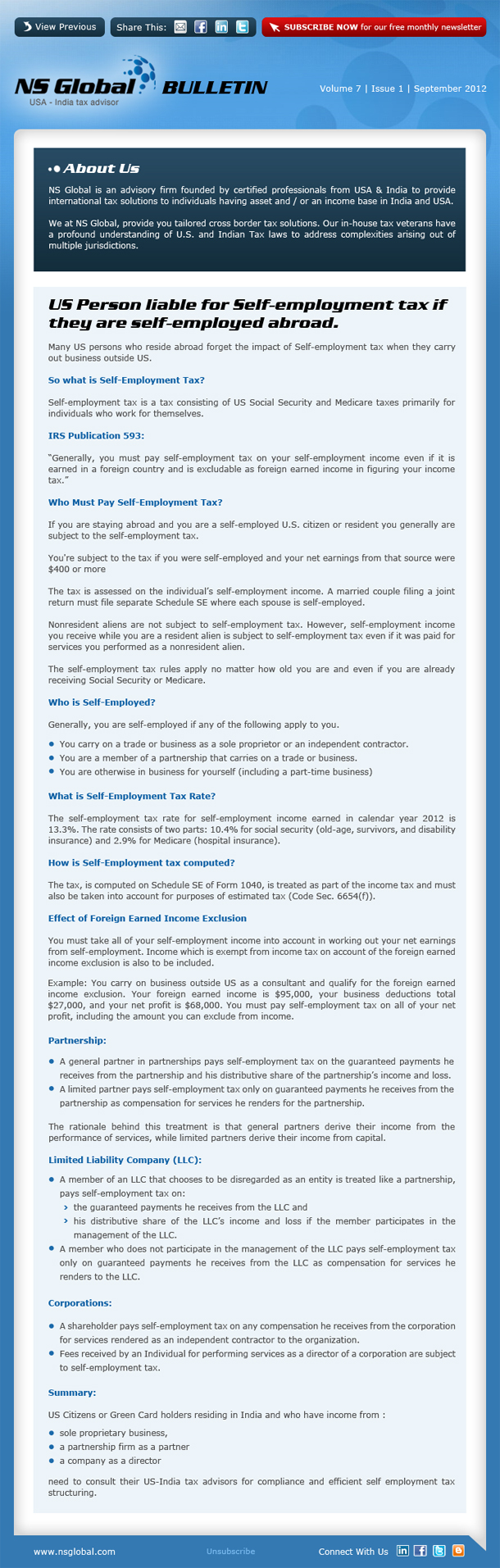
US Person liable for Self-employment tax if they are self-employed abroad.

Posted by Sanket Shah | Newsletters | Friday 7 September 2012 4:15 pm
September Header
Newsletter - September 2012

NSGlobal Newsletter - September NSGlobal Newsletter - September NSGlobal Newsletter - September NSGlobal Newsletter - September NSGlobal Newsletter - September NSGlobal Newsletter - September Unsubscribe Linkedin Facebook Twitter Blog
Share

Tax implications in India and US on sale of property held by US person in India

Posted by Sanket Shah | Newsletters | Tuesday 7 August 2012 10:52 am

NEWSLETTER SYNOPSIS:
Do you own, plan to purchase
or anticipate to receive an
immovable property in India.
What are the tax implications in
India and US on sale of property
held by US person in India.

August Header
Newsletter - August 2012

NSGlobal Newsletter - July NSGlobal Newsletter NSGlobal Newsletter NSGlobal Newsletter NSGlobal Newsletter NSGlobal Newsletter Blog Twitter Facebook Linkedin Unsubscribe
Share

Taxability of [Indian] PPF Interest in USA

Posted by Sanket Shah | Newsletters | Thursday 26 July 2012 5:52 pm
July Header
Newsletter - July 2012

NSGlobal Newsletter - July NSGlobal Newsletter - July NSGlobal Newsletter - July NSGlobal Newsletter - July NSGlobal Newsletter - July NSGlobal Newsletter - July Blog Twitter Facebook Linkedin Subscribe
Share
« Previous PageNext Page »
Copyright @ 2011 NS Global.